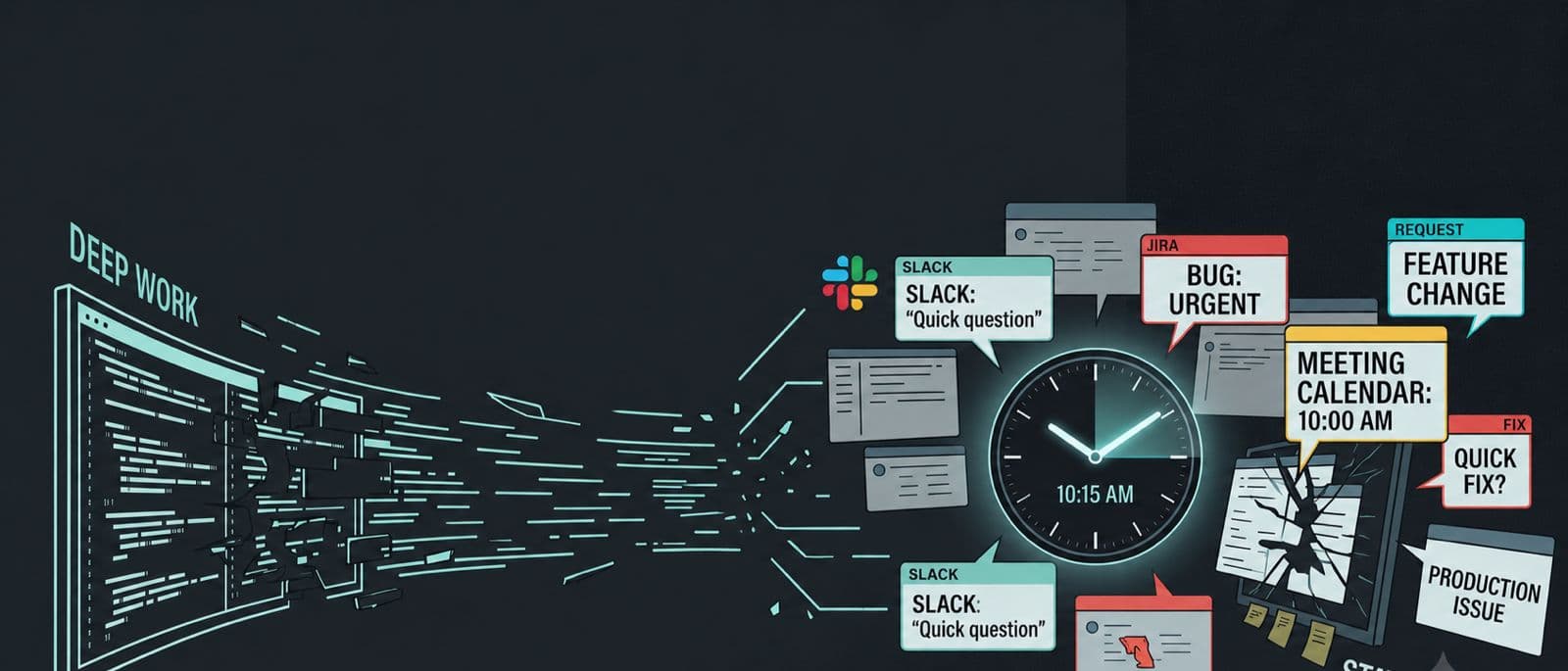
Most developers are not slow because they lack skill.
They are slow because their focus gets destroyed throughout the day.
A developer starts working on a feature.
Halfway through, a Slack message comes in.
Then a bug report.
Then a meeting.
Then another “quick change.”
Then a production issue.
By the end of the day, nothing meaningful actually gets finished.
This is context switching.
And it quietly destroys developer productivity inside startups and teams.
The problem with development work is that coding is not only typing.
Developers need deep mental context:
• understanding system flow
• remembering dependencies
• tracking logic
• understanding architecture
• thinking through edge cases
Every interruption breaks that mental state.
And rebuilding that focus takes far longer than people realise.
A 2 minute interruption rarely costs 2 minutes.
It often costs:
• 15 minutes
• 30 minutes
• sometimes even an hour of regained focus
Now multiply this across an entire week.
This is why many developers feel “busy” all day but still feel like they shipped very little.
The dangerous part is that context switching often looks productive from the outside.
Lots of meetings.
Lots of replies.
Lots of updates.
Lots of task movement.
But actual deep work output decreases.
Startups especially struggle with this because everything feels urgent.
Developers are constantly pulled into:
• random calls
• last minute changes
• unclear requests
• multiple parallel tasks
• unnecessary status updates
Over time, this creates fragmented execution.
Good engineering teams protect focus aggressively.
Not because developers dislike communication.
But because uninterrupted thinking is essential for building quality systems.
Some of the highest performing engineering teams reduce context switching by:
• batching meetings
• reducing unnecessary notifications
• limiting parallel tasks
• creating deep work blocks
• documenting properly instead of constant interruptions
The difference becomes massive over time.
A focused developer working deeply for 4 hours can outperform an interrupted developer working 10 hours.
This is also why clear systems matter.
Poor communication creates more interruptions.
Poor planning creates more task switching.
Poor management creates more chaos.
Eventually, the issue is no longer technical.
It becomes operational.
Most teams think productivity means making developers work more.
In reality:
Productivity often means helping developers switch less.
Because every context switch has a hidden cost.
And most startups are paying that cost daily without realising it.