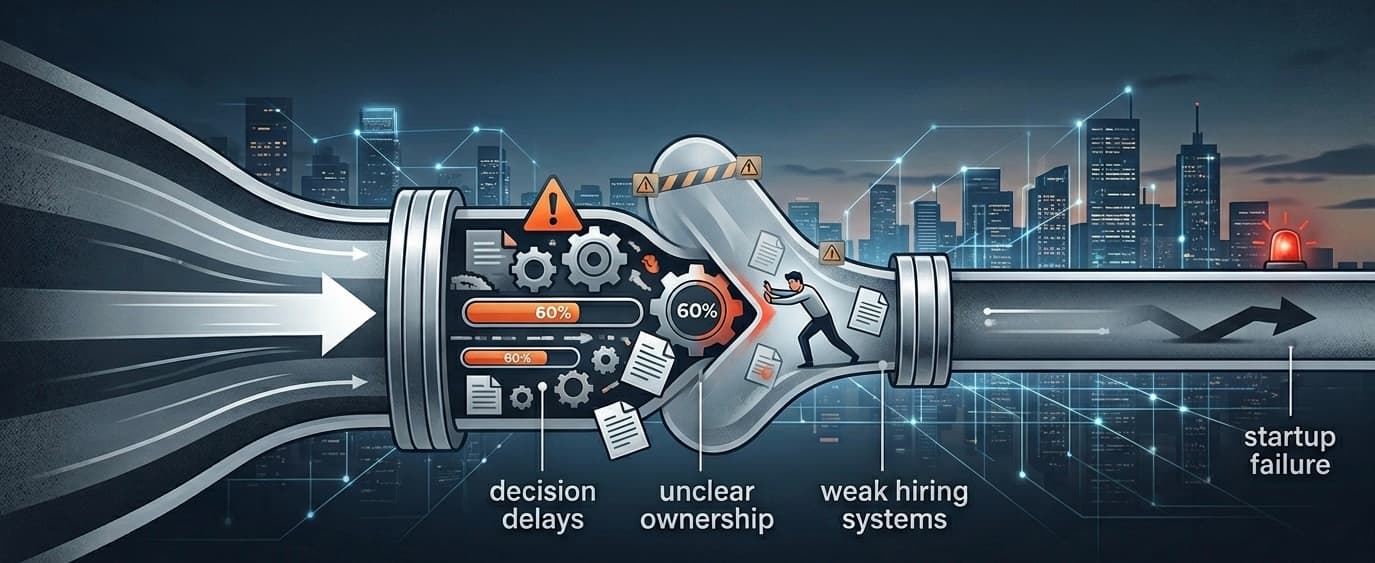
Most startups do not fail because of bad ideas.
They fail because they cannot execute fast enough.
On the surface everything looks right. There is a strong product, a capable team, and clear goals. But behind the scenes small delays start adding up.
• Tasks take longer than expected
• Decisions keep getting pushed
• Progress feels slow despite effort
This is not a strategy problem.
This is an execution bottleneck problem.
Where do execution bottlenecks come from
1. Decision delays
Too many decisions depend on founders or leadership
Teams wait instead of moving forward
Even simple approvals take time
Result
Work slows down and momentum breaks
2. Unclear ownership
No clear responsibility for tasks
Work gets passed around or repeated
Accountability is missing
Result
Work is done but outcomes are weak
3. Weak hiring systems
Hiring takes too long
Wrong hires reduce efficiency
Existing team gets overloaded
Result
Execution quality drops and speed decreases
4. Lack of structured processes
Work depends on chats and follow ups
No clear tracking of tasks
Things get missed or delayed
Result
Execution becomes unpredictable
5. Over optimisation
Teams try to perfect everything before shipping
Too much time is spent refining instead of releasing
Result
Nothing moves fast enough to matter
What fast startups do differently
Make decisions quickly
Assign clear ownership for every task
Build repeatable systems instead of relying on memory
Hire through structured processes
Focus on progress instead of perfection
The reality
Execution is not about working harder.
It is about removing friction.
The fastest teams are not always the smartest.
They are the ones that move with clarity and speed.
If your startup feels slower than it should be, the problem is not effort.
The problem is hidden bottlenecks inside your system.
Fix the bottlenecks and growth follows.
Ignore them and even the best ideas will struggle to survive.